TL;DR: Under-deck drainage systems and under-deck ceiling panels both keep the space below your deck dry — but they’re built around different priorities. Ceiling panels are an all-in-one product that doubles as a finished ceiling. A dedicated drainage system like DEK Drain® leads with water management and framing protection, then lets you finish the ceiling however you like. Here’s how the two approaches compare, and where each one is most effective.
Water dripping through your deck boards is more than a nuisance. Left alone, it can rot framing, feed mold and mildew, and turn the space below your deck into a place nobody wants to be. Two categories of product promise to fix that: under-deck ceiling panels and under-deck drainage systems.
These solutions are often mentioned in the same breath, and they do overlap. But they aren’t the same thing by any stretch — and the difference matters when you’re deciding how to protect, and how to use, the space beneath your deck.
What Under-Deck Ceiling Panels Do Well
Under-deck ceiling panel systems are designed to perform two functions simultaneously: catch water and provide a finished ceiling, all in one product. Most use interlocking vinyl or aluminum panels that install below the joists, channel water toward a gutter, and leave a clean, ceiling-like surface overhead.
The appeal is obvious. You get drainage and a finished look from one system, with a uniform appearance right out of the box. For homeowners who want a “done-in-one” solution and are happy with the manufacturer’s style, that’s a real draw.
The trade-offs are worth understanding, though:
- Many panel systems are built from vinyl or aluminum. Plastic components can grow brittle, fade, or warp after years of sun exposure and temperature swings.
- Because the panels mount beneath the joists, water travels across your frame before it’s captured — so while the area below stays dry, the structural wood above the panels isn’t necessarily protected.
- Because the ceiling is the product, you’re generally locked into that manufacturer’s panel profiles and color palette.
What Under-Deck Drainage Systems Do Exceptionally Well
A dedicated drainage system takes a different approach: its first job is managing water and protecting your deck, and the finished ceiling is left up to you.
DEK Drain® is a fine example. Our flagship TOPSIDE® system installs above the joists, before the deck boards go down, capturing rainwater before it ever reaches the framing. That’s a meaningful distinction — the structure stays dry, not just the space below it. For decks that are already standing, our UNDERSIDE® system installs beneath the joists to reclaim the space below without tearing up the surface.
Because our system is built from a 45-mil rubber membrane rather than plastic, it stays flexible across a vast temperature range — down to -50°F — and doesn’t share plastic’s tendency to grow brittle over the years.
DEK Drain® requires no glue, caulk, or adhesives, runs long panels with no joints to seal, and is backed by the only fully transferable, non-prorated limited lifetime warranty in the category.
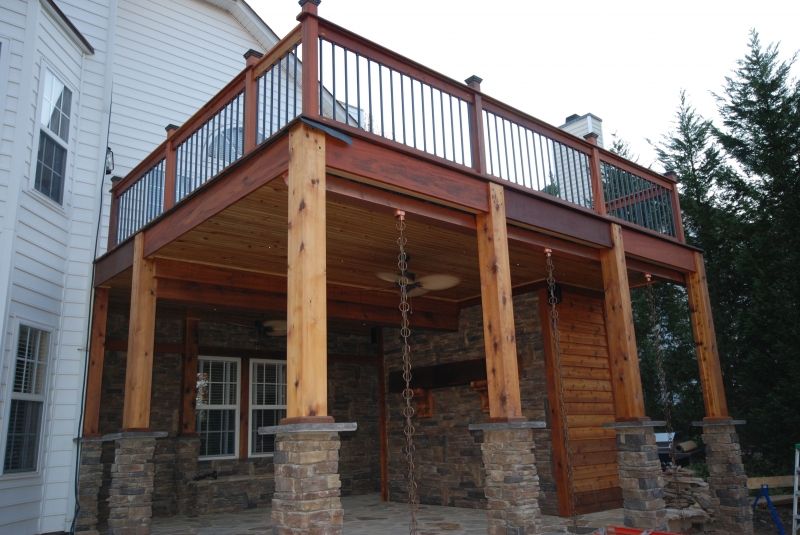
The one thing a drainage membrane doesn’t do on its own is serve as your finished ceiling. If you want that polished look underneath, ceilings can be added separately. This is also what gives you complete freedom to finish the space in whatever material and style you want, from tongue-and-groove to recessed lighting and fans. Our UNDERSIDE® Recessed system is designed specifically to make that easy. For many homeowners, that flexibility is a winning feature, not a drawback.
So, Which Option Is Right for You?
If you care most about protecting your deck’s framing, want a material built to outlast plastic, value a lifetime warranty, and like the idea of finishing the ceiling exactly the way you want, a dedicated drainage system is likely the better long-term investment. With DEK Drain®, you don’t actually give up the finished ceiling — you just get to decide what it looks like.
Under-deck ceiling panels and under-deck drainage systems both keep you dry. The difference is priorities: ceiling panels lead with the finished look, while a drainage system leads with water management and long-term protection, then hands you the design freedom to finish the space your way. For those thinking in decades, not seasons — that combination of durability, framing protection, and a lifetime warranty is almost impossible to beat.
Explore our TOPSIDE® and UNDERSIDE® systems online and reach out to our team today to get started.
***
FAQs
What’s the difference between under-deck drainage and under-deck ceiling panels?
A drainage system’s main job is capturing water and protecting your deck; a ceiling panel system doubles as a finished ceiling. With a drainage system, you add the ceiling of your choice separately.
Do ceiling panel systems protect the deck framing?
Not always to the same degree. Many install below the joists, so water crosses the framing before it’s captured. An above-joist system like TOPSIDE® keeps the framing itself dry.
Can I still get a finished ceiling with DEK Drain?
Definitely. DEK Drain® manages the water so you can install a finished ceiling — with lighting, fans, and more — in the material and style you prefer.
Are plastic ceiling panels less durable?
Plastics can become brittle or fade due to years of UV exposure and temperature swings. DEK Drain’s rubber membrane is built to stay flexible down to -50°F and resist that kind of breakdown.
Which option lasts longer?
It depends on the materials, but a rubber-membrane drainage system backed by a fully transferable lifetime warranty is designed for decades of performance.